Alan Glynn has won the Crime Award for "Bloodland" in the 2011 "Irish Book Awards".
His field of action continues to chart the ability of contemporary protagonists to go AWOL at what seems to
be the slightest provocation. Underlying their apparently bizarre behaviour patterns is a society at war.
Everybody these days is being told "You know you're over reacting". Fortunately writers like Alan Glynn
come along to explore why.
I'll get round to writing more about "Bloodland" when the moment is more opportune.
Here, just to pass the time is a re-write of a piece written two years ago.
"Winterland" is the first of a series that looks set to continue for quite some time.
>>>>>>>>>>>>>>>>>>>>>>>>>>>>>>>>>>>>>>>>>>>>>>>>>>>>>>>>>>>>>>>>>>>>
Gina Rafferty simply cannot leave well enough alone.
She asks questions... too many for her own good,
or so it seems to those who have most to lose
through her revelations.
Dublin, in "Winterland" is a veritable Tower of Babel,
with 'phones ringing... not being answered...
being answered by the wrong people... where email messages float by unnoticed
by those whose lives are being manipulated by their contents.
Viewing the story as a contemporary myth,
the transformation of a gentle businesswoman whose company is on the verge of collapse into an avenging principle of vengeance
is today's daily news and gender is not particularly relevant.
For those in the corridors of power, battling to put the fiscal disasters of recent years to right, the temptation to see such stories
in terms of a classic Greek tragedy must be tempting.
Alan Glynn's sense of humour, is often, in my reading linked to melodrama and vaudeville.
Boucicault, the fine interpretor of why people are so happy to tell white lies to get through life,
would enjoy a story where the straight talking heroine is pursued by a bewitched, bothered and bewildered villain (the usual concoction of
booze and drugs) and whose only hope is a hero who ends up in hospital, suffering from communication problems
that only a person who has tried to use a mobile 'phone in Ireland would appreciate.
However Noir buffs may opt for a more cynical view of human nature.
How and ever, the award is very well deserved.
Monsieur Glynn.... Chapeau!
(Or as Schumann said when he first discovered Chopin.... "Hats off, gentlemen...."
But that's another story...)
Showing posts with label Alan Glynn. Show all posts
Showing posts with label Alan Glynn. Show all posts
Saturday, November 19, 2011

Friday, November 11, 2011
Oh No! Not Emerald Noir Again!
Writers are so thin skinned when it comes to getting their work categorised.
That's not a criticism, as I would never bother to write a book for sale on the world market just because of the annoyance all the misunderstandings would cause. There is nothing like a literary spat to get in the way of a good day's work.
I can understand Alan Glynn's simple explanation that his "novels" are not written to fit into some commercial formula.
His ability to explore themes that are up to date and seem to resonate with today's readers as if they were designed to be socially relevant is not the brief, it seems. Jung's theory of the collective unconscious (if there is such a phenemenon) accounts for many of the similarities in theme and subject matter that many writers share. And language is the real giveaway, unless one is writing pastiche.
However when it comes to placing books on shelves in a bookshop I doubt if putting the crime writers into the pharmacology or self-help sections would be of much value. Recently I made a "faux pas" by referring to "Bloodland" as "historical fiction" which made one wicked friend ask if the characters were carrying muskets. Since anything further back than six hours ago fits into history in my book, I apologised (as usual) and hoped that I had not contributed to the demise of both civilisation and the book industry.
And just in passing, Emerald Noir conjures a nighmare scenario in my mind of a third hood in an Edward G Robinson film dressed like a leprechaun.
(For a discussion about the ups and downs of Noir and its links to melodrama it's worth dropping over to Peter Rozovsky's blog and view the post entitled "What does Noir Mean to You?"
Friday, November 4, 2011
Location in Literature
Novelists have to study the society they choose to document with a gimlet eye. Put a character in the wrong social context and the reader will think the writer lazy or stupid.
My admiration for their endeavours is enormous as most of the work is buried beneath the surface of the final text and research takes an eternity. Paying a researcher would probably be essential if one were to want to be prolific. I often think that the major names of the past had a retinue of people round them to make sure details were correct and the interminable letters they were compelled to write, checking details in places they could not visit, must have left many of them with a hefty expenditure every year.
That, when you think of it, is what makes buying a book such a remarkably good bargain. For the cost of an average bottle of wine one has access to an item, well presented, and bursting with entertainment or information (or preferably both).
I know that a lot of people are annoyed at the number of new "books" that will first see the light of day as e-books. I don't seem to be able to find much personal annoyance in this and the market will usually dictate the form. If more and more people read on public transport while commuting, a book is more efficiently carried as a small computer and there is less chance of it being damaged.
I like reading online and the light from the computer is probably helping me avoid seasonal affective disorder even though I don't usually suffer from it. I'm forever dropping bits of food onto my books so the computer is a nicer way of getting through the day without causing a mess.
Reading in bed is another matter, as a book is such a manageable object and can even induce sleep. I've often wondered if there is a gene for compulsive reading, as once I found books there was no stopping my desire to possess and read them, morning, noon and (with a flashlight) night. The style of presentation is as important as the subject matter and the cheap editions with mean small print were not a favourite at any time.
That is where the American book industry comes into its own. Writers who would never get published have an industry and educated public which can support some of the most beautiful hard backs one could ever dream of. My French paperbacks continue to fall to bits at the seams (cheap glue). Irish books have cover art that I often find to have some nefarious link to the national colour schemes as officially perceived. They make my eyes smart. But for absolute security and pleasure, nothing beats a cookery book published in Britain or a gardening one by the French (or vice versa).
I have avoided writing much about my great coup in having a photo chosen as a book cover for Alan Glynn's American edition of "Winterland". This is not based on modesty as, in true gallic fashion, I am very proud of having got to manage such a herculean task. Twenty years ago I practiced saying "No!" until it became a reflex, even in my sleep. There is no point in inviting trouble and books, whatever their subject matter, are always trouble. They are very precious because of that and the hopes and energy of so many people are involved that to not pull one's weight would be a very great problem in the long run.
So, it was with great horror that I set out to send a photo the size of a billboard measured in pixel size to New York. I continue to be eternally grateful to Tommy Kavanagh in Boards.ie who put me on the right track when I had not a clue what I was supposed to do. The copyright laws I signed remind me of the system that finally captured Al Capone and I ended up worrying that, if the blessed book did not sell, somehow the cover would be suspected of not being up to scratch.
All worries have been dispelled, however, by the lively social life that such risk taking has ensured. Trotting off to book readings, (never without a copy of the book which is not available in Europe), is a pleasure that only the editors who encouraged such foolhardy behaviour knew would result, is now quite a regular occurrence.
Also, it has given me the courage to write truly complicated sentences again.
Once published in New York, one can say anything one likes, within reason.
And it is a very well written book...
Thursday, October 27, 2011
A Fashionable Pursuit?
This is a really good piece about Conspiracy Theory:
"http://www.huffingtonpost.co.uk/alan-glynn/conspiracy-theories-and-t_b_917903.html"
(I've stopped live linking, as so many sites seem to conspire against me...)
Having finished "Bloodland" by Alan Glynn, it is now safe to reveal that it is what was once called "a rattling good read".
The characters are engaging, the plot has zap and is plausible, or at least it seems so from my scant viewing of television news reports.
Most people are safe from conspiritors. We are so small and inconsequential that the high dramas reserved for those in the public eye just pass us by.
Just as well, I suppose...
Tuesday, October 25, 2011
Too Much of a Bad Thing?
I have reached the end of my very short tether with conspiracy theory writing.
"Down These Green Streets" is the latest port of call in an ongoing search for the meaning of
Celtic Noir as it has hit the headlines recently. This book, a collection of essays by practitioners in the genre,
is a very helpful guide to current trends in publishing worldwide, not just in Ireland.
There is much analysis of the split between "literature" and "popular" writing, or genre fiction as the latter
is so often called. There is mention of the effect that thirty years of "Troubles" has had on the collective
psyche of writers. Ongoing references insist that Irish writers see themselves as working on a wider canvas
than that afforded by a national literature and America is invoked constantly as a place, both real and imaginary,
where Irish people have found a voice.
I have to admit that most of the analysis is very far away from my own experience of reading.
Having studied French for years and having been compelled to read most of the Existentialist writing of the
post-WW2 generation, I finally took refuge in Proust and Colette. These writers operate on a more domestic
and psychological scale. They seem to be closer to my everyday lived reality and, for style combined with substance,
they are hard to beat.
Somehow "hard-boiled" has never had much allure for me. I think that people are kinder and more mis-directed
than crime writers would seem to admit. Real people blunder through life as best they can. Finding cause and effect,
meting out punishments that fit crimes, forming reasonable explanations for the human condition ... all these make noir fiction
a satisfying read. Ends are tied up securely, the reader can actually feel safe after the ordeals suffered by the protagonists.
This is not my lived experience...
Thursday, October 13, 2011
Roaring On Alone...
I suppose I should take "Ireland" more seriously...
After all, I live on this delightful, if somewhat damp, little island and think daily about the circumstances that have led me to enjoy getting up every day to keep a house and garden in check.
Somehow the whole post-boom post-Celtic-Tiger misery has passed me by. I don't think that getting angry about economics (that gloomy subject) or working myself into a frenzy about fiscal matters will advance the cause of humanity.
However, since I'm reading "Bloodland" by Alan Glynn, a certain amount of energy is spent each day wondering how to put things to rights again. The book is meant as a cautionary tale of how the World's economy is now tightly knitted into a system from which none of us can escape. Innocence about trade is a thing of the past. Africa continues to supply vast amounts of important metals that everybody uses daily. Coltan is much in the news and Mr Glynn, a clever innovator when it comes to coining new words, has invented a rare metal that is linked to the Greek word for death... thanatos.
I have to admit that gardeners tend to think much more about life. This month will be spent moving a veritable mountain of leaves to a slow decaying compost area. Don't believe that you cannot compost leaves, btw. Interspersed with layers of soil and softer kitchen refuse everything becomes useful mulch material in a matter of months.
So far, nobody seems to garden in Mr Glynn's fictional universe. Perhaps that is one of the many reasons that I find it so engagingly strange?
Thursday, September 22, 2011
Θάνατος
Yesterday's post about noir fiction reminded me of why I chose to be a gardener.
The literature of our trade is rich and rooted in the daily existence of every person who breathes and lives on our jolly little blue-green Planet.
It all started in a garden, if the sages of old are to be believed, and while death is acknowledged as inevitable by those who tend the soil, it is part of the order of things and life always returns.
If you ever go to Angers, do not miss a visit to the Tapestries by Jean Lurçat. In one, a single plant struggles to survive in a vastness of post-nuclear fallout... or so it seemed to me.
The joyful colours of life reborn are everywhere in the series.
In this context, I re-opened "Bloodland" by Alan Glynn this morning and tried, yet again, to engage with narrative voice and a very new vocabulary. What is "thanaxite"? Why are the drugs that the characters swallow in seeming handfuls in all the Glynn novels not listed in the Internet's pharmacopoeia?
And the insistence that characters have on getting one another to talk...
Umberto Eco once mentioned in a somewhat lack-lustre talk he gave in UCD, that the search for "Truth" was a particularly Western pre-occupation.
This impulse seems to be in full bloom in the current spate of noir novels that are causing readers to gather in conventions in New York and to compile reading lists for the return to the Reading Groups' coalface as I write.
And "Bloodland", as is beginning to dawn on me, is truly within the canon of Irish literature. Why did Susie die? Jimmy wants to know...
And the talking, the eternal flow of words designed to hide secrets and silence.
In the finest noir style, the book deals many deathly blows along the way. Large Corporations are evicerated, symbolically at least. People are frightened.
"This is how it goes. You get talking to someone, you interact, and it all starts to fall apart."
And it seems, from the vantage point of my little apple orchard, that Mr Glynn does have ways of making his characters talk than are not dreamt of in my philosophy...
Wednesday, September 21, 2011
This Land is Our Land?
There is a problem that leads to much heated discussion among readers of crime fiction. It is that noir fiction and popular writing is seen as less "serious" than "literature".
And it is probable that this is never going to be solved.
The history of the novel continues, a river of words in full spate, with everybody having an opinion on where
it may be heading. Having lived through "The Death of the Novel" in the 1970's, which I had not the energy to
take seriously and now faced with a plague of thrillers that have replaced the bouncy Chick Lit of the Boom Times,
I suppose the only option is to go with the somewhat erratic flow.
I have an excuse for not diving headlong into "Bloodland" ... I could not follow a plot to save my life
and my idea of inexorable nightmare is to go back to reading Shakespeare. Hamlet really tired me...
Politics I still regard as the haven for a lot of shouty people who can't seem to make a coherent sentence or answer any question good, bad or
indifferent. History from the scant attention I gave it in school, seems to have been compiled not only by the
victors, but by anybody who was still left alive after some grotesque plague or battle and had access to writing
implements.
Not a good start...
So rather than review "Bloodland" by Alan Glynn, it might be more useful to look at its topicality.
Since people now live increasingly in cities, noir is suitable as a genre within the tradition of
Robert Louis Stephenson, Bram Stoker and Arthur Conan Doyle. There is usually something nasty lurking
in the shadows away from the bright street lights. The wonderful noir films of the 1940's and early 50's are
the highlight of the genre for me, but Alan Glynn is always quick to remind readers of his particular affinity
with the paranoid films of the 1970's when corrupt activities by governments filled the newspapers.
Having spent hours listening to (mostly male) friends belabour the ups and downs of Watergate, I have little taste for
any more discomfort when it comes to bedtime reading. Nixon's statement on being found out in a mistruth.. "I mis-spoke myself" ...actually made me laugh at the time... but then I have a sense of humour that makes most real life dramas seem ridiculous.
But back to the writer in hand...
On first reading, "The Dark Fields" (now remodelled as "Limitless") brought back memories of Ray McInerney's
"Bright Lights, Big City" and Tom Wolfe's "Bonfires of the Vanities". The frantic consumerism of 1980's New York
finally has found its place firmly in every city on the Planet. Friends who have been to Moscow are stunned by
the glittering shopper's paradise that this once grim place has become. Ex-Pat wives around the world have
very little to do of a day apart from shop and consume.
The greed culture of everyday life is introduced very early in "Bloodland" as the reality of life in the Congo is juxtaposed with the calm
domesticity of the average European housewife. Nobody knows the horrors that the male protagonists have seen and up to the point that I have read, the women are not interested.
This I recognise. When friends who worked in Africa came back to find what Europeans considered to be a problem it caused rifts and invitations stopped being sent back and forth. I found them hardened, they found me
trivial and self-indulgent. One useful outcome was that their stories made me take the measure of my own inadequacies. Nothing would get me to the places they described.
The coltan trade, as explored by Mr Glynn is not for the faint of heart,
but anybody who listens regularly to "From Our Own Correspondent" on Radio Four will be quick to see where the roots of this novel lie.
Without the trade in rare metals, I could not sit writing this piece and have the expectation that it will, within seconds, appear on the Internet. I stopped buying little ivory gifts in the past, as that was the commodity shown to be destructive to life in the Congo. Oil was in the news for a considerable number of years, as the living conditions of those who stole from piplines was a constant and dismaying reality. That, I have to admit did not stop me driving a car.
There is much in the news about the coltan trade and anybody looking for more information on mining in the Congo could find this useful:
cellular-news.com/coltan/
Capicitors cannot function without this highly prized metal.
Actions have consequences as I expect to find as I read on in "Bloodland".
This novel deals with a world that is in the direct line from the highly moral writers of the early 20th Century who insisted on holding the mirror up to social issues. We live in a global community so the cacophany of voices that has so bewildered me as I read the first few chapters is exactly right. It is like channel hopping on TV and finding a confused and somewhat shattered representation of reality.
And everywhere is the possibility of violence.
Unlike so many who insisted on lauding Joseph Conrad's "Heart of Darkness" in class, I was more interested in the fact that Conrad had a very serious nervous breakdown as a result of what he had seen during
his travels. It is a truly terrifying book.
And, as Joseph conrad was always quick to understand... we are all in the same boat.
It is strange therefore, that it is so little known about Mr Glynn in Dublin at the moment.
Perhaps this is about to change?
Friday, September 16, 2011
Independent Bookshops...
... are thin on the ground these days.
So it was a great pleasure to find a friendly venue in Temple Bar this week. Dutifully carrying my camera fitted with the kit lens (an item much unjustifiably maligned by experts) I wandered through streets I had not seen in years.

I used haunt Cecilia Street in search of music tips from the people in Claddagh Records in the 1980's, but since our local library now has a fine selection of CDs and there is music everywhere thanks to the Internet, shopping in this area seems no longer necessary.
The Gutter Bookshop is not a seedy dive as the name might at first suggest. Also it is in a very photogenic and quiet part of town.

The name references Lord Darlington in Wilde's "Lady Windermere's Fan"
"No, we are all in the gutter, but some of us are looking at the stars."
And the reason for such exertions on a bright, chilly evening in September? Alan Glynn's new thriller, "Bloodland", was given its official launch with a reading by the author. The introduction was helpful in approaching the book. There is so much argy bargy about genre among noir and thriller writers at the moment that it was a relief to be told, simply, that Mr Glynn's preference has always been for Shakespeare's historical plays and that the novel in question, set in Ireland, Italy, the US and the Congo is within the "political thriller" tradition.

I have started reading it and it makes my head spin.
That, for anybody wishing to be thrilled and intrigued, should probably be taken as a compliment.

So it was a great pleasure to find a friendly venue in Temple Bar this week. Dutifully carrying my camera fitted with the kit lens (an item much unjustifiably maligned by experts) I wandered through streets I had not seen in years.
I used haunt Cecilia Street in search of music tips from the people in Claddagh Records in the 1980's, but since our local library now has a fine selection of CDs and there is music everywhere thanks to the Internet, shopping in this area seems no longer necessary.
The Gutter Bookshop is not a seedy dive as the name might at first suggest. Also it is in a very photogenic and quiet part of town.
The name references Lord Darlington in Wilde's "Lady Windermere's Fan"
"No, we are all in the gutter, but some of us are looking at the stars."
And the reason for such exertions on a bright, chilly evening in September? Alan Glynn's new thriller, "Bloodland", was given its official launch with a reading by the author. The introduction was helpful in approaching the book. There is so much argy bargy about genre among noir and thriller writers at the moment that it was a relief to be told, simply, that Mr Glynn's preference has always been for Shakespeare's historical plays and that the novel in question, set in Ireland, Italy, the US and the Congo is within the "political thriller" tradition.
I have started reading it and it makes my head spin.
That, for anybody wishing to be thrilled and intrigued, should probably be taken as a compliment.
Sunday, January 23, 2011
A Cri de Coeur
A strange pattern has emerged.
Whenever I show the Saint Martin's Press edition of Alan Glynn's "Winterland" to friends they
shout enthusiastically.
"Oh, yes... John Connolly!!!"
I draw their attention to the unfamiliar name of the author, written in much larger font, and
they peruse the photoin the fly leaf with interest... puzzled interest and growing admiration
when they learn that "The Dark Fields", now pithily called "Limitless" has just hit the silver screen.
I have become so zealous in letting people know about Alan Glynn that I'm in danger of
becoming that most known of Irish stereotypes "The Character".
In Gunn's photography shop the other day, a lively discussion ensued when, presented with the cover art,
we argued the toss about "the photographer's eye". I was having none of it. All you need is a tripod and
keep the camera steady is my philosophy. The image is already there in the world around us, and a bit of
nifty toning never goes amiss. Atget's name came up again. His duotones continue to astonish me and
offer inspiration when it comes to colour contrasts.
Alan Glynn has been featured on the national news recently and is set to be a very popular writer among thriller fans.
Here is one of the covers of his second novel, "Winterland", set in the original Baroque Garden in Dublin...
Thursday, August 12, 2010
It's Debateable?
Alan Glynn has explained that he wrote "Winterland" as a novel.
However, marketing requires categories and every aspect of a book speaks to a niche group of potential buyers.
I have become very interested in the very different iconography used in Europe and in North America
to promote popular literature, regardless of genre.
It is useful to look at different editions of the same book on Goodreads.
Also, it may be helpful to dig deeper and explore whether the publishing houses set the agenda
when it comes to what is considered to be valuable.
Or is the public somehow setting down a series of unconscious needs that writers and artists
respond to?
Writers will by unlikely to enjoy the implications of such questions, as they, above all, cherish freedom of form and of expression.
The number of writers discussing zombie themes (often with eyes rolled evocatively and, given the genre,
suitably, to Heaven) on the Internet these days is evidence of a very real fear that one's work may not
be appreaciated... or in some cases, even read. I have a friend whose children's books came second in
the favourites list to stories about blobby green creatures and it was not a pleasant experience.
It is heartening to see that from a position of being left on the literary shelf,
Mr Glynn's "novel" is now set to be among the stars.
(Also, in passing, and with apologies for using your comment forum for a personal aside,
I twice tried to post the following comment on Pattinase's blog, in response to the
question about what one is reading at present. It was eaten... twice...
"Winterland by Alan Glynn.
It's riveting, in every sense. The presence of Dublin as a modern city is central and the characters (apart from the baddies) are likeable. Corruption in high places is the main theme and this may have contributed to the book's success. It has been hailed as an analysis of Post-Boom Ireland, where the Celtic Tiger is dead.
Emerald noir is very fashionable, it seems.")
Mr Rozovsky's mention of philosophical intent has alerted me to one aspect of "Winterland" that I found unusual.
It is a remarkably ethically sound (and in some ways, old fashioned) novel. Descriptions of the more
violent characters come with large moral labels, placed by an invisible narrative voice.
I am used to 20th century French writing and the looser, often amoral tones of its authors.
Could it be that the some 21st century writers are cast in the mould of a late 19th century, ameliorating philosophies?
I thought of Ibsen while reading "Winterland" and although he does not agree with any comparison to heavy lifters, Mr Glynn's book
has an almost Dostoyevskian vigour and is a page turner. "Crime and Punishment" is among the first crime thrillers and the
plotting is impeccable, expecially when it comes to the Doppleganger theme between the hunter and the hunted.
Let's see what everyone thinks...
Tuesday, June 29, 2010
Some Summer Reading... "Winterland"
I liked "Winterland" so well I bought a copy for a friend recently.
The sense of place, where you can feel that Dublin is a thriving city, is very impressively
described and the aesthetic link with Joyce's Sandymount Strand at the end is hard to miss.
Alan Glynn has captured the dislocations between private and public life in a brave new
Republic where citizens struggle to make lives and ends meet. Anybody who has ever been
hospitalised in Ireland will enjoy the sheer surrealism of the struggles between patient and
institution towards the end of the book. I have to admit I laughed out loud several times as
I was suddenly brought to a grisly realisation of how visceral Irish hospital life can be.
I have to admit to a bout of total cowardice when it came to the pages where thuggish gentlemen
meet in an isolated building on the edge of the city. Fast foward several pages and
it is unlikely that I will ever read them.
I watched "The General" on television again at the weekend and switched channel whenever
the action became too painful. This opens up the question about who mostly reads thrillers
and crime fiction, a question that is being discussed on many blogs at the moment. While reading groups,
mostly frequented by ladies of leisure, are quick to choose fashionable titles to analyse, many readers
admit to jumping pages when violence raises its many heads.
This has left me wondering if squeamishness is genetic or learned. If I ever come to a full explanation on this, I'll be certain to share it here...
Monday, May 17, 2010
Cover Story
Really, it's all about survival...
The book trade, like so many other industries, is, it seems, "in crisis". I know not "seems" and crisis is OTT in my book.
If you want to do something in life... well, just do it.
Having made a comment about graphics on Crimesceneni, I have given a lot of thought to the visual aspect of blogs and why some of them are pleasant to look at. We are now so overwhelmed by iconography that blindness to contemporary images may be in sight. I find I often close my eyes, rather than look.
This is because wild colour schemes, images with the "wow" factor, shocking juxtaposition of themes and crazy fonts are now so prevalent in the public sphere that it is actually a relief to find something "ordinary" out there.
I have a vested interest in knowing more about the publishing world. It is not a monetary interest, more a projection into the future, when the years of photos I have accumulated will have become mementos of the past. Reading Proust on the subject of photography helps to find a pathway through all the issues that bedevil writers and artists at the moment. What sells may seem a crass question.
But it is important when it comes to marketing books.
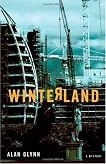 Winterland by Alan Glynn
"Winterland", by Alan Glynn
Mr Glynn very kindly sent me a synopsis of his book, which is categorised as a literary thriller
with noir over and under tones,
rather than as a gritty crime novel.
"It has elements of the crime thriller in it, but I wrote it simply as a novel.
The main character in the book is a young woman, Gina Rafferty, who refuses to be lied to.
Two deaths occur in her family on the same night and she refuses to accept that it was a coincidence.
Her pursuit of an honest answer leads her through the worlds of business,
politics and crime and to the unravelling of a dynamic in Irish life where people tell lies, cover them up, create all sorts of collateral damage over decades and never take responsibility.
One strand of the plot involves the construction of a high rise office building down in the docklands by a man who becomes Gina's nemesis or opposite.
One of the things I was trying to do with these two characters was create a simultaneous sense that 'the centre cannot hold' and that actually maybe, with adjustment, it can.
In an exciting abstract way I see an echo of that in your image."
Much has been written about the astonishing greed of the past fifteen years.
However, the Celtic Tiger did bring a sense of vitality to our lives and now
that we are in post-boom times, our artists are offering considered explorations of
what exactly seems to have happened and "where it all almost went wrong".
I am an optimist. I expect that Alan Glynn will manage to get the centre to hold
in his much anticipated novel.
I have read that Mr Glynn has regard for James Joyce, who seems to have settled into the role of venerable patriarch to the city's numerous writers.
Dubliners, whose city motto is "Obedienta Civium Urbis Felicitas"...
"Happy the city where citizens obey"..
are survivors. There is more to their story than the ones told through the moroseness of the many writers who chose exile rather than live in a place that did not suit their psychological needs.
Since the world of publishing is now a global phenomenon it is heartening to see writers living in our city and following its narrative as insiders at last.
Dublinia
posted by Tales from the Birch Wood. at 4:38 PM
3 Comments:
Blogger DaviMack said...
Congratulations on getting published, then! Cover art? Woo!
10/15/2009 6:56 PM
Blogger Cathy said...
Congratulations indeed! Will be looking out for the book and its cover.
10/16/2009 8:47 AM
Blogger Tales from the Birch Wood. said...
Thank you both.
It has been a dramatic few months and certainly a reason to focus more clearly on photography.
Cover art is very fashionable, it seems.
View all my reviews >>
The book trade, like so many other industries, is, it seems, "in crisis". I know not "seems" and crisis is OTT in my book.
If you want to do something in life... well, just do it.
Having made a comment about graphics on Crimesceneni, I have given a lot of thought to the visual aspect of blogs and why some of them are pleasant to look at. We are now so overwhelmed by iconography that blindness to contemporary images may be in sight. I find I often close my eyes, rather than look.
This is because wild colour schemes, images with the "wow" factor, shocking juxtaposition of themes and crazy fonts are now so prevalent in the public sphere that it is actually a relief to find something "ordinary" out there.
I have a vested interest in knowing more about the publishing world. It is not a monetary interest, more a projection into the future, when the years of photos I have accumulated will have become mementos of the past. Reading Proust on the subject of photography helps to find a pathway through all the issues that bedevil writers and artists at the moment. What sells may seem a crass question.
But it is important when it comes to marketing books.
Winterland by Alan Glynn"Winterland", by Alan Glynn
Mr Glynn very kindly sent me a synopsis of his book, which is categorised as a literary thriller
with noir over and under tones,
rather than as a gritty crime novel.
"It has elements of the crime thriller in it, but I wrote it simply as a novel.
The main character in the book is a young woman, Gina Rafferty, who refuses to be lied to.
Two deaths occur in her family on the same night and she refuses to accept that it was a coincidence.
Her pursuit of an honest answer leads her through the worlds of business,
politics and crime and to the unravelling of a dynamic in Irish life where people tell lies, cover them up, create all sorts of collateral damage over decades and never take responsibility.
One strand of the plot involves the construction of a high rise office building down in the docklands by a man who becomes Gina's nemesis or opposite.
One of the things I was trying to do with these two characters was create a simultaneous sense that 'the centre cannot hold' and that actually maybe, with adjustment, it can.
In an exciting abstract way I see an echo of that in your image."
Much has been written about the astonishing greed of the past fifteen years.
However, the Celtic Tiger did bring a sense of vitality to our lives and now
that we are in post-boom times, our artists are offering considered explorations of
what exactly seems to have happened and "where it all almost went wrong".
I am an optimist. I expect that Alan Glynn will manage to get the centre to hold
in his much anticipated novel.
I have read that Mr Glynn has regard for James Joyce, who seems to have settled into the role of venerable patriarch to the city's numerous writers.
Dubliners, whose city motto is "Obedienta Civium Urbis Felicitas"...
"Happy the city where citizens obey"..
are survivors. There is more to their story than the ones told through the moroseness of the many writers who chose exile rather than live in a place that did not suit their psychological needs.
Since the world of publishing is now a global phenomenon it is heartening to see writers living in our city and following its narrative as insiders at last.
Dublinia
posted by Tales from the Birch Wood. at 4:38 PM
3 Comments:
Blogger DaviMack said...
Congratulations on getting published, then! Cover art? Woo!
10/15/2009 6:56 PM
Blogger Cathy said...
Congratulations indeed! Will be looking out for the book and its cover.
10/16/2009 8:47 AM
Blogger Tales from the Birch Wood. said...
Thank you both.
It has been a dramatic few months and certainly a reason to focus more clearly on photography.
Cover art is very fashionable, it seems.
View all my reviews >>
Thursday, February 18, 2010

Subscribe to:
Posts (Atom)


